About
A plant with a thousand-year story
Wasabi is a member of the cabbage family, native to Japan's mountain river valleys. What we eat is its thick stem, or rhizome — grated fresh, just before serving.
History
From mountain herb to sushi icon
Wasabi appears in Japanese records as early as the 8th century, first gathered wild as a medicinal herb. Cultivation began around 400 years ago in Utogi, a village in Shizuoka, where farmers transplanted wild plants into spring-fed streams.
In the Edo period, Tokugawa Ieyasu was so taken with it that the plant was guarded as a treasure — its leaf even resembles the Tokugawa crest. With the rise of nigiri sushi in Edo (Tokyo) street stalls, wasabi became inseparable from raw fish.
The plant
Leaves, stems, flowers and rhizome
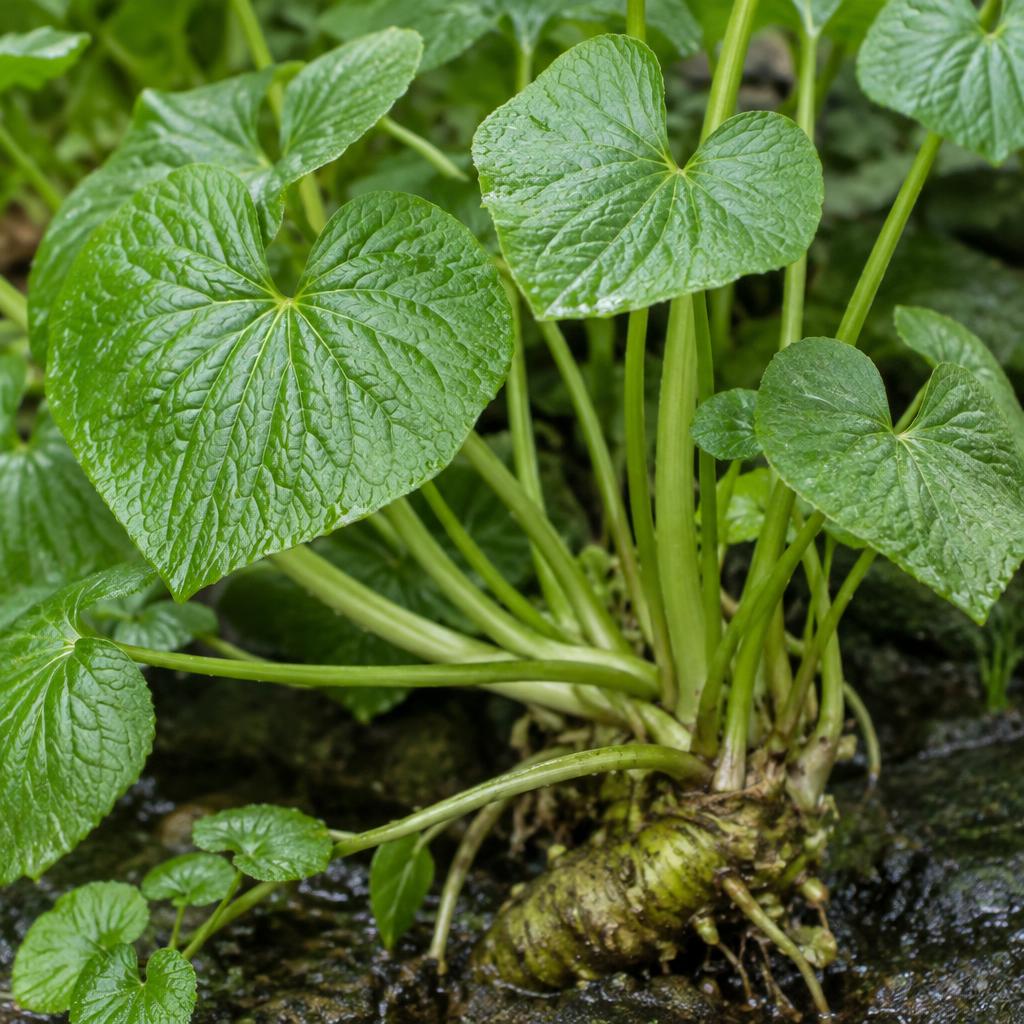
- Rhizome — the knobbly stem, grated for its famous heat. The top end is the most prized.
- Leaves — heart-shaped and peppery, eaten as tempura, pickles or in salads.
- Stems — crunchy, pickled in sake lees as wasabi-zuke.
- Flowers — small white blossoms in early spring, a seasonal delicacy.
Real vs fake
What's really on your plate?
| Real wasabi | Typical “wasabi” paste | |
|---|---|---|
| Plant | Wasabia japonica rhizome | Horseradish root + mustard |
| Color | Natural pale, jade green | Bright green from dye |
| Heat | Sweet, aromatic, fades in seconds | Sharp, harsh, lingers in the nose |
| Texture | Fine, moist, slightly fibrous | Smooth paste |
| Price | Around €200–300 per kg | A few euros per tube |
Flavor
Why the heat disappears so fast
Intact wasabi isn't hot at all. When grating ruptures its cells, an enzyme called myrosinase meets compounds called glucosinolates and produces allyl isothiocyanate — the volatile molecule behind the rush of heat. Because it evaporates, the flavor peaks after a few minutes and fades within about 15. Unlike chili, it rises into the nose rather than burning the tongue.
Health
More than a condiment
Antibacterial
Isothiocyanates inhibit bacteria such as E. coli and Staphylococcus — one reason it is served with raw fish.
Anti-inflammatory
Studies suggest wasabi compounds may calm inflammatory responses in the body.
Rich in nutrients
The plant contains fiber, potassium, calcium and vitamin C.
General information, not medical advice.